

The research group has made significant progress in the study of non-Hermitian quantum systems.
Recently, the experimental research group led by Professors Suo-Tang Jia, Lian-Tuan Xiao, and Yan-Ting Zhao from the Institute of Laser Spectroscopy, together with their theoretical collaborator Professor Ying Hu, published a research paper entitled "Exceptional Nexus in Bose-Einstein Condensates with Collective Dissipation" in Physical Review Letters, a leading international journal in physics.
The paper's first author is Ph.D. student Chen-Hao Wang, with corresponding authors being Professor Yan-Ting Zhao and Professor Ying Hu. Professor Zhong-Hua Ji and Professor Bo Yan from Zhejiang University also participated in this research. This work was supported by the National Key R&D Program, the National Natural Science Foundation of China Key Projects, and General Programs.
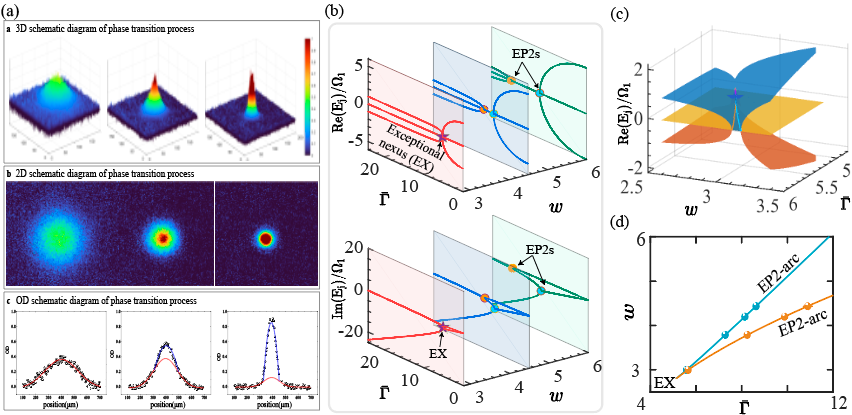
The research team proposed and, for the first time, experimentally realized an asymmetric exceptional nexus using ultracold atoms. Non-Hermitian physics, prevalent in open dissipative systems, breaks through the traditional framework of closed systems, revealing unprecedented physical phenomena and application potentials. A particularly notable phenomenon in higher-order non-Hermitian systems is the exceptional nexus, formed by the intersection of multiple exceptional arcs, exhibiting unique mixed topological charges and anisotropic fractional responses. By utilizing dissipative Bose quantum gases, the team constructed a higher-order non-Hermitian Hamiltonian. Through sophisticated dissipation control, they observed, for the first time in an ultracold atomic system, the convergence of exceptional arcs with different geometric configurations and the resulting asymmetric exceptional nexus. This discovery opens new avenues for exploring exotic non-Hermitian physics in dissipative quantum gases and developing non-Hermitian control techniques.
Atomic and Molecular Quantum Manipulation Laboratory
June 2024